


Overview
Traffic insights help you decide where to focus your SEO effort before you waste time updating pages with little upside. Instead of guessing which URLs need work, you can use Google Search Console to see which pages already have visibility, which ones attract impressions but underperform on clicks, and which pages are quietly losing organic traffic. This creates a practical roadmap for smarter content optimization.
For most websites, the fastest SEO gains do not come from rebuilding everything. They come from improving pages that are already close to performing well. A page ranking on the lower half of page one, or appearing often for relevant searches without earning enough clicks, is usually a better opportunity than a page with no search visibility at all. That is why strong SEO teams start with data, not assumptions.
High-impact SEO priorities usually live in pages that already show signs of demand, relevance, and ranking potential
This article explains how to use traffic insights to identify those opportunities first. You will learn how to prioritize pages by SEO impact, detect high-impression low-click URLs, spot early traffic declines, and connect search queries to search intent. You will also see how to find quick-win updates and measure performance before and after changes. When done consistently, this process helps turn raw Search Console data into a focused system for growing sustainable organic traffic.

How to prioritize pages for seo impact
The first step in setting smart SEO priorities is separating pages with real upside from pages that are unlikely to move the needle. In Google Search Console, review performance by page and compare clicks, impressions, average position, and trend lines over the last 3 to 6 months. Pages with strong impressions and mid-range rankings often deserve attention first because they already have visibility and need only targeted improvements to grow.
A useful way to prioritize is to look at pages through three filters: business value, existing search demand, and ease of improvement. A service page tied to revenue should usually outrank a low-intent blog post in your workflow, especially if both show similar traffic potential. The goal is not just more traffic, but more valuable traffic.
- High impressions + average position 5–20: often the best optimization targets
- Pages tied to conversions: important even if traffic is moderate
- Evergreen content: easier to improve and sustain over time
- Pages with outdated information: often quick wins with limited effort
Prioritization becomes even stronger when you combine page data with your site’s broader strategy. If your brand focuses on automation and scalable SEO growth, for example, pages related to recurring demand and on-page improvements may deserve first attention. A clear scoring system keeps your team focused and makes traffic insights actionable rather than overwhelming.
Identify high-impression low-click pages
One of the clearest opportunities inside Google Search Console is the page that receives many impressions but too few clicks. This usually means Google already sees the page as relevant, but searchers are not choosing it. In many cases, the issue is not ranking alone. It may be a weak title tag, an unclear meta description, poor alignment with the query, or a search result that does not stand out against competitors.
Start by sorting pages by impressions and then comparing click-through rate. If a page has thousands of impressions and a below-average CTR for its position, it should move higher on your optimization list. Review the exact queries driving visibility and ask whether the page title clearly reflects what the searcher wants. Also check whether the content promise matches what appears in the snippet.
A page with high impressions has already earned Google’s attention; your job is to earn the click
Improving these pages often leads to quick gains in organic traffic because the underlying visibility already exists. Focus on practical updates such as rewriting title tags, improving meta descriptions, strengthening H1s, clarifying page purpose, and adding more specific value near the top of the content. If the page ranks for multiple intents, consider narrowing its focus or expanding the content so it better satisfies the dominant search need.
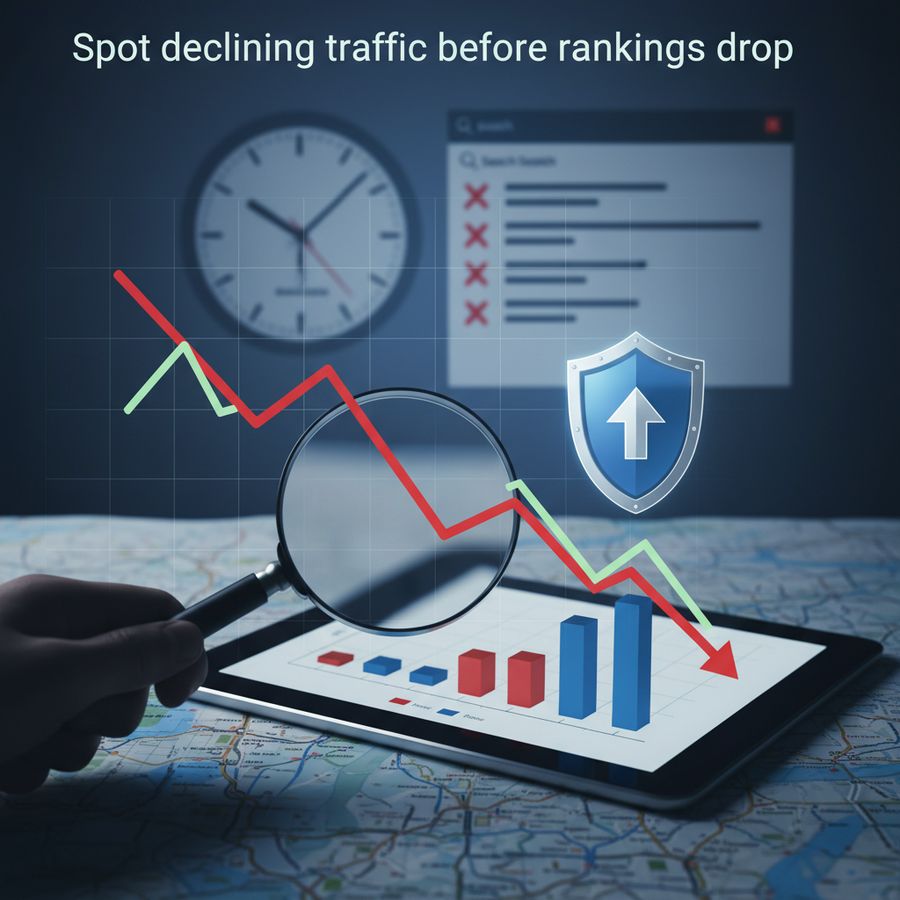
Spot declining traffic before rankings drop
Traffic declines do not always begin with a major ranking crash. In many cases, the first warning sign is softer: fewer clicks from previously stable queries, a drop in impressions for core terms, or lower engagement from pages that once performed consistently. Monitoring these early signals helps you act before a high-value page loses significant search visibility.
In Google Search Console, compare recent periods against previous periods and look for pages with downward movement in clicks and impressions. Then review the query mix. If the same page is still ranking but receiving less traffic, the issue may be changing search demand, stronger competitors, stale content, or declining relevance. These signals often appear weeks before a page fully slips in rankings.
Common reasons for early decline include outdated statistics, incomplete answers, weaker internal linking, or newer competing pages that better match user expectations. A page can remain indexed and visible while still becoming less compelling to both users and Google over time.
- Watch pages with consistent historical traffic
- Compare the last 28 days to the previous 28 days
- Check whether impressions, clicks, or CTR dropped first
- Review freshness, intent match, and internal links
By treating traffic loss as an early diagnostic signal, you make content optimization more proactive. That approach protects existing wins and keeps your SEO strategy from becoming reactive and expensive.
Use queries to map intent to pages
Strong SEO is not only about ranking for more terms. It is about ranking the right page for the right intent. Query data in Google Search Console shows how users actually find your content, and that makes it one of the best tools for matching search intent to existing pages. When a page attracts queries with mixed or mismatched intent, performance often stalls.
Review the top queries for each important URL and group them into common intent types such as informational, commercial, navigational, or transactional. Then compare that pattern with the page’s purpose. If a product or service page is attracting mostly educational queries, it may need more explanatory content. If a blog post is ranking for high-buying-intent terms, it may need stronger conversion paths or even a dedicated landing page.
Better intent matching often improves rankings, click-through rate, and conversion quality at the same time
This process also helps reduce cannibalization. If multiple pages compete for similar queries, Google may struggle to understand which page should rank. Clarifying page roles, refining internal links, and adjusting on-page messaging can help direct authority to the correct URL.
Intent mapping turns raw keyword data into something more strategic. Instead of chasing every query, you build a cleaner site structure where each page serves a distinct purpose. That leads to better SEO priorities, clearer content decisions, and stronger long-term organic traffic growth.
Find content gaps and quick-win updates
Not every optimization requires a complete rewrite. Some of the best gains come from finding content gaps within existing pages and fixing them quickly. Using traffic insights, you can spot pages that already rank for valuable queries but fail to fully answer related questions. These gaps often appear in Search Console when a page gets impressions for secondary keywords that are only lightly covered in the content.
For example, a page may rank for a broad topic but miss supporting details, examples, comparisons, or practical steps. Filling those missing sections can improve relevance without changing the core URL. This is especially useful for evergreen posts and service pages where small updates can create measurable gains in organic traffic.
- Add missing subtopics suggested by query data
- Refresh outdated examples, numbers, or screenshots
- Strengthen introductions and key takeaways
- Improve internal links to related supporting pages
- Update titles and headings to reflect user language
Quick-win updates are valuable because they are efficient. Rather than publishing more content just to increase volume, you improve the assets that already have some authority and visibility. This approach aligns well with scalable SEO systems, especially when teams want better results from existing content before investing in new production. Over time, these targeted updates compound into a stronger, more resilient content library.
Benchmark before-and-after performance changes
Without benchmarking, it is hard to know whether an SEO update actually worked. Before making changes to a page, record the baseline metrics in Google Search Console: clicks, impressions, average position, CTR, and top queries. If possible, also note conversions, engagement metrics, and internal link context. This creates a reliable reference point for evaluating impact instead of relying on memory or assumptions.
Use a fixed comparison window, such as 28 days before and 28 days after the update, while accounting for seasonality if relevant. For pages with lower traffic, a longer measurement period may provide a more accurate picture. The key is consistency. If you change titles, rewrite sections, improve internal links, and add new content all at once, document each action so you can connect outcomes to specific optimizations.
What gets measured gets improved, but only when the benchmark is clear enough to trust
When reviewing results, avoid judging performance by rankings alone. A page can improve in position but show limited click growth if the query mix changes. Likewise, CTR gains can produce more traffic even with stable rankings. The best analysis looks at the full picture: visibility, click behavior, intent alignment, and business value.
Benchmarking also improves future decision-making. Once you understand which changes consistently raise performance, your team can prioritize similar updates across other pages and refine its broader content optimization process.
Conclusion
Finding pages worth optimizing first is one of the most practical ways to improve SEO efficiency. Rather than spreading effort across an entire site, use traffic insights to focus on URLs that already show visibility, business relevance, or early signs of decline. That means reviewing impression and click data, identifying weak CTR opportunities, mapping queries to intent, and strengthening pages with targeted updates.
Google Search Console provides much of the evidence you need to make these decisions with confidence. When you build a repeatable workflow around impressions, clicks, rankings, and page-level trends, you stop treating SEO as guesswork. You start making informed decisions about where to invest time for the highest return.
The biggest advantage of this approach is momentum. Small, well-chosen improvements on the right pages can lead to stronger organic traffic, better conversion potential, and clearer SEO priorities over time. Instead of chasing every opportunity equally, you create a disciplined optimization process built on real performance data.
In short, the best pages to optimize first are rarely a mystery. The signals are already there. Your job is to read them correctly, act on them consistently, and measure what changes next.