
By the Boostifai Team. Updated November 2026. All studies and figures checked on November 5, 2026.
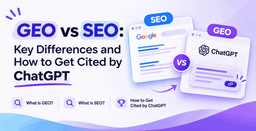
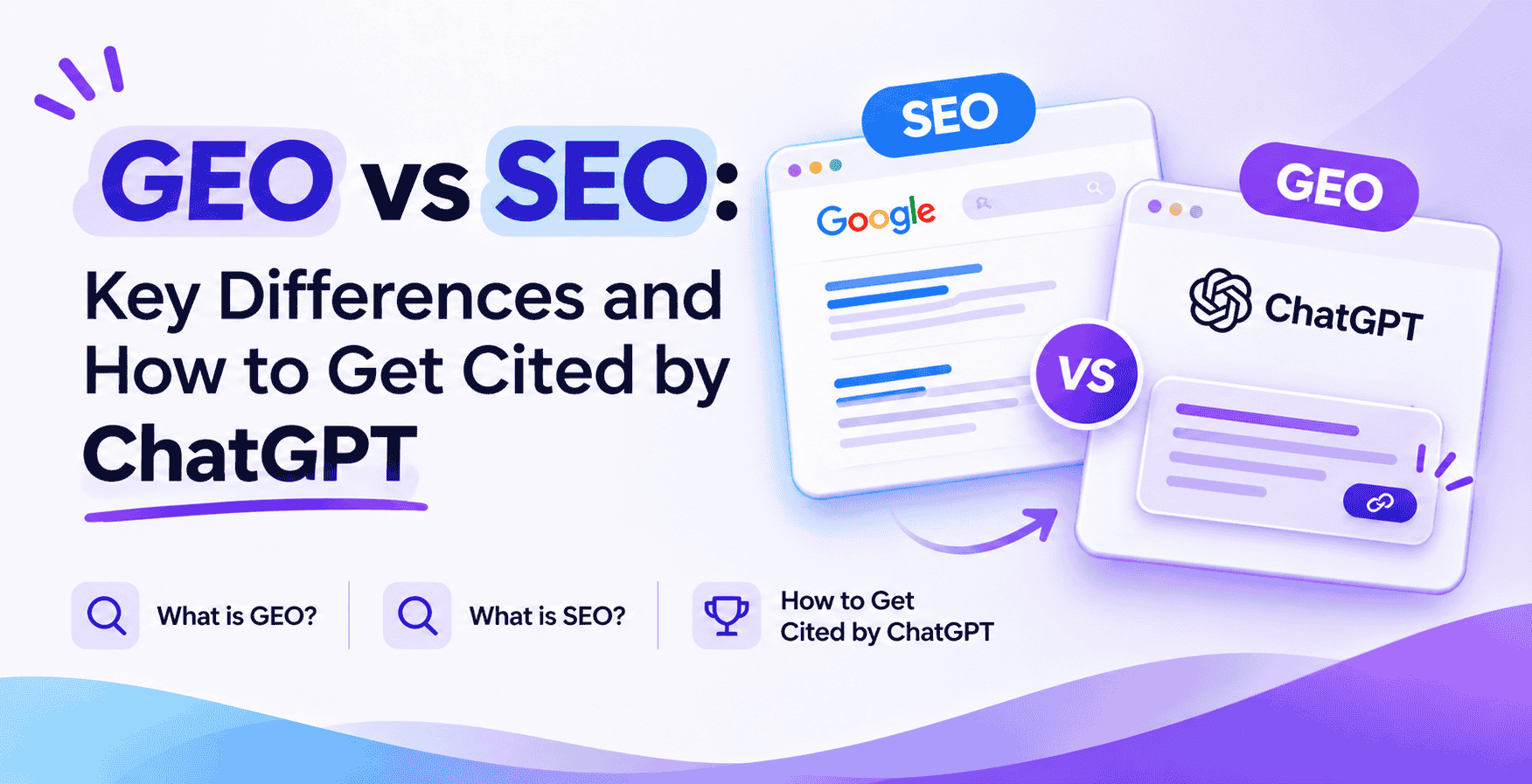
SEO earns rankings and clicks in search results. GEO, short for generative engine optimization, earns mentions and citations inside AI answers from ChatGPT, Perplexity, Gemini, Claude and Google’s AI Overviews and AI Mode. They share the same foundation, and Google itself says that optimizing for its AI features is still SEO. What changes is how AI systems pick sources, how you measure success, and a few technical details, such as whether AI crawlers can read your pages at all.
Key Observations
- GEO is SEO with a different scoreboard: how often AI answers mention or cite you, instead of where you rank and how many people click.
- In the original GEO study, adding quotes, statistics and cited sources made content up to about 40% more visible in AI answers. Keyword stuffing did not help.
- AI answers change with almost every run. One study found ChatGPT and Google’s AI had less than a 1 in 100 chance of giving the same list of brands twice, so measure your share over many runs.
- Our own focused posts are already being cited: on November 5, 2026, Google AI Mode listed Boostifai blog posts as the first source for two questions our blog covers.
- Google says there are no extra requirements and no need for an llms.txt file to appear in AI Overviews or AI Mode.
What is the difference between GEO and SEO?
SEO is the work of getting your pages to rank in search engines like Google and Bing. GEO is the work of getting your brand mentioned and your pages cited when an AI tool writes an answer. The skills overlap heavily, but the output, the measurement and some of the technology differ.
| Aspect | SEO | GEO |
|---|---|---|
| Goal | Rank pages in search results | Be mentioned or cited in AI answers |
| Where it happens | Google and Bing results pages | ChatGPT, Perplexity, Gemini, Claude, Google AI Overviews and AI Mode |
| What people type | Short keywords | Longer, conversational prompts |
| How results are built | A ranked list of pages | One answer assembled from several sources, often after running extra searches behind the scenes |
| Main metric | Rankings, clicks and click-through rate | Share of answers that mention or cite you, sentiment and AI referral visits |
| Stability | Rankings move gradually | Answers change with almost every run |
| Crawlers | Googlebot renders JavaScript | Most AI crawlers read the raw HTML only |
| Content that wins | Relevant, helpful, trustworthy pages | The same, plus clear facts, statistics, quotes and sources that are easy to lift into an answer |
Is AEO the same as GEO?
Mostly, yes. AEO, or answer engine optimization, started with featured snippets and voice assistants. Today AEO, GEO and LLM SEO are used for the same goal: showing up inside AI-generated answers. The name matters less than the method.
Is GEO replacing SEO?
No. Google’s AI features documentation says there are no additional requirements to appear in AI Overviews or AI Mode. A page needs to be indexed and eligible to show a snippet, the same as for regular search. Google’s AI optimization guide goes further and calls this work “still SEO”.
That matches how AI search works. Google describes a process called query fan-out, where the system runs several related searches and then builds one answer from the results. Pages that are easy to find and trust in regular search are easier for AI to find too.
Ranking is not the whole story, though. Ahrefs data reported by Search Engine Journal in March 2026 found that 38% of AI Overview citations came from pages ranking in the top 10, down from 76% in July 2025. Ahrefs changed its method between the two studies, so part of the drop may reflect better citation detection. Either way, pages outside the top 10 can still be cited.
Does AI search still send clicks?
Fewer than classic search, and that is why the scoreboard changes. In Pew Research Center’s study of 900 US adults’ browsing in March 2025, users clicked a search result 8% of the time when an AI summary appeared, against 15% when it did not. Only 1% clicked a link inside the summary itself.
Being cited still pays. Seer Interactive’s 2026 update across 53 brands found that on informational queries, brands cited in AI Overviews averaged a 2.07% organic click-through rate over the year, against 0.94% for brands that were not cited. Seer notes that one large account pulls the second figure down; without it, the gap narrows to 2.07% against about 1.61%.
How do AI engines choose which sources to cite?
A useful starting point is the research paper that named the field. In GEO: Generative Engine Optimization by Aggarwal and colleagues, presented at KDD 2024, the authors tested nine content changes on a benchmark of 10,000 queries.
Three findings are worth knowing:
- Adding quotations, statistics and cited sources raised a page’s visibility in AI answers by roughly 30% to 40%.
- Keyword stuffing gave little to no improvement, and on Perplexity it performed about 10% worse than doing nothing.
- Lower-ranked pages gained the most. With cited sources added, the fifth-ranked page gained 115% in visibility while the top-ranked page lost 30%.
Treat these as direction, not law. The tests used GPT-3.5 and five Google results per query back in 2023. Newer AI systems may behave differently, so test the pattern on your own pages.
AI answers also cite pages beyond your own site, such as reviews, comparison articles and community threads. That is why GEO includes earning genuine mentions on sites your buyers already trust.
How do you get cited by ChatGPT?
There is no switch to flip, but these steps raise your odds.
- Let OpenAI’s search crawler in. OpenAI’s crawler documentation explains that OAI-SearchBot decides whether your pages can appear in ChatGPT search, while GPTBot collects training data. Blocking GPTBot does not remove you from ChatGPT search, but blocking OAI-SearchBot does. Check your robots.txt.
- Make sure your content works without JavaScript. Vercel and MERJ’s December 2024 crawler study found that none of the major AI crawlers, including OpenAI’s and Anthropic’s, run JavaScript. They read the raw HTML.
- Answer the question in the first one or two sentences of each section, then explain.
- Add evidence: a statistic with its source, a short quote from a named expert, a link to the original study.
- Write what only you can write. Google’s guide asks for non-commodity content: first-hand experience, your own data, real examples.
- Earn real mentions on other sites through reviews, comparisons, interviews and helpful answers in communities. Do not fake them.
- Update pages when something actually changes, and show the date.
What does this look like on a real page?
Here is how we rewrote the opening of an older version of this article.
Before: “AI search does not work like a classic list of ten blue links. Traditional SEO aims to rank pages for a query and win clicks from a results page.”
After: “GEO vs SEO comes down to the scoreboard. SEO is judged by rankings and clicks. GEO is judged by how often AI answers mention or cite you. In Pew Research Center’s March 2025 data, Google users clicked a result 8% of the time when an AI summary appeared, against 15% without one.”
The second version answers the question, uses a number and names its source. That is the kind of passage an AI system can lift and cite.
Do AI answers already cite Boostifai’s blog?
Yes. On November 5, 2026, we asked Google AI Mode two questions that our blog covers. For “where do GEO audits and SEO rankings overlap”, the first source it listed was our post on GEO audits and SEO rankings, and the answer cited it. For “rank tracking cadence for faster SEO decisions”, the first source was our guide to rank tracking cadence.
Each of those posts covers one specific question. AI answers change from run to run, so treat this as a snapshot and check your own pages across many questions over time.
What do you not need to do for GEO?
Google’s AI optimization guide includes a short myth-busting list. According to Google, you do not need to:
- Create an llms.txt file. Google Search does not use it, and Google says it will neither help nor harm your rankings.
- Break your content into small chunks for AI.
- Rewrite your pages specifically for AI.
- Add special schema just for AI features.
- Chase inauthentic mentions of your brand.
The same guide warns that creating pages for query fan-out mainly to manipulate AI answers can count as scaled content abuse. Write for people first.
How do you measure GEO results?
Start by accepting that AI answers move. In SparkToro’s January 2026 study, 600 volunteers ran the same 12 prompts 2,961 times across ChatGPT, Claude and Google’s AI. For ChatGPT and Google’s AI, there was less than a 1 in 100 chance of getting the same list of brands twice, and Claude was only slightly more consistent. The same list in the same order came up about once in 1,000 runs. How often a brand appears turned out to be a usable measure. Its position in the list did not.
A practical setup:
- Choose 20 to 30 questions your buyers ask, with a few phrasings of each, and keep the list fixed.
- Run them regularly and track the share of answers that mention or cite you, not your position.
- In Google Analytics 4, track visits from ChatGPT. OpenAI’s publisher FAQ says ChatGPT adds utm_source=chatgpt.com to its referral links.
- For Google, AI Overviews and AI Mode traffic is reported in Search Console under the Web search type, according to Google’s AI features documentation.
- Log every change you make, so you can connect results to actions.
Boostifai’s AI Insight shows how ChatGPT, Gemini, Claude and DeepSeek describe your brand over time, with a visibility score, sentiment and the products each model links to you. It is included in every Boostifai plan. For a free first look, run the GEO audit tool.
What should you do this week?
- Check robots.txt and confirm OAI-SearchBot, PerplexityBot and Googlebot are allowed.
- Open the source of your five most important pages and confirm the title, description and main text are in the raw HTML.
- Rewrite the first two sentences of each of those pages so they answer the main question directly.
- Add one sourced statistic or one named expert quote to each.
- Set up a fixed list of buyer prompts and record a baseline.
If you would rather not do the on-page part by hand, Boostifai’s AI recommendations find and apply these fixes after your approval, and AI Articles keeps your blog publishing.
Frequently asked questions
What is the difference between GEO and SEO?
SEO aims to rank pages in search results and win clicks. GEO aims to get your brand mentioned and your pages cited in AI answers. Both rely on helpful, trustworthy, crawlable content.
Is SEO dead because of AI search?
No. Google says optimizing for its AI features is still SEO, and AI tools often search the web before they answer. What changes is how you measure success and how you write for answers.
What is the difference between AEO and GEO?
AEO, answer engine optimization, began with featured snippets and voice answers. GEO focuses on generative AI answers. Today the terms are used almost interchangeably.
How do you get cited by ChatGPT?
Allow OAI-SearchBot in robots.txt, make sure your content is in the raw HTML, answer questions directly, add sourced facts and quotes, and earn genuine mentions on sites people trust.
Does llms.txt help AI visibility?
Not in Google. Google says its Search does not use llms.txt and that creating one will neither help nor harm your visibility or rankings.
Do AI crawlers read JavaScript?
Most do not. A December 2024 study by Vercel and MERJ found that the major AI crawlers, including OpenAI’s and Anthropic’s, only read the raw HTML. Google’s crawler does render JavaScript.
Why does ChatGPT give different answers each time?
AI models generate a new answer for every request. SparkToro’s 2026 study found less than a 1 in 100 chance of ChatGPT or Google’s AI returning the same brand list twice, so track averages over many runs.
How do you track ChatGPT traffic in Google Analytics?
ChatGPT adds utm_source=chatgpt.com to links it sends, according to OpenAI. In GA4, look for chatgpt.com as the session source in your traffic acquisition report.